The tooth we
decided to keep.
Fifty percent bone loss and a 6 mm pocket. The guidelines say extract. Here's why we tried to save it, and what that takes.
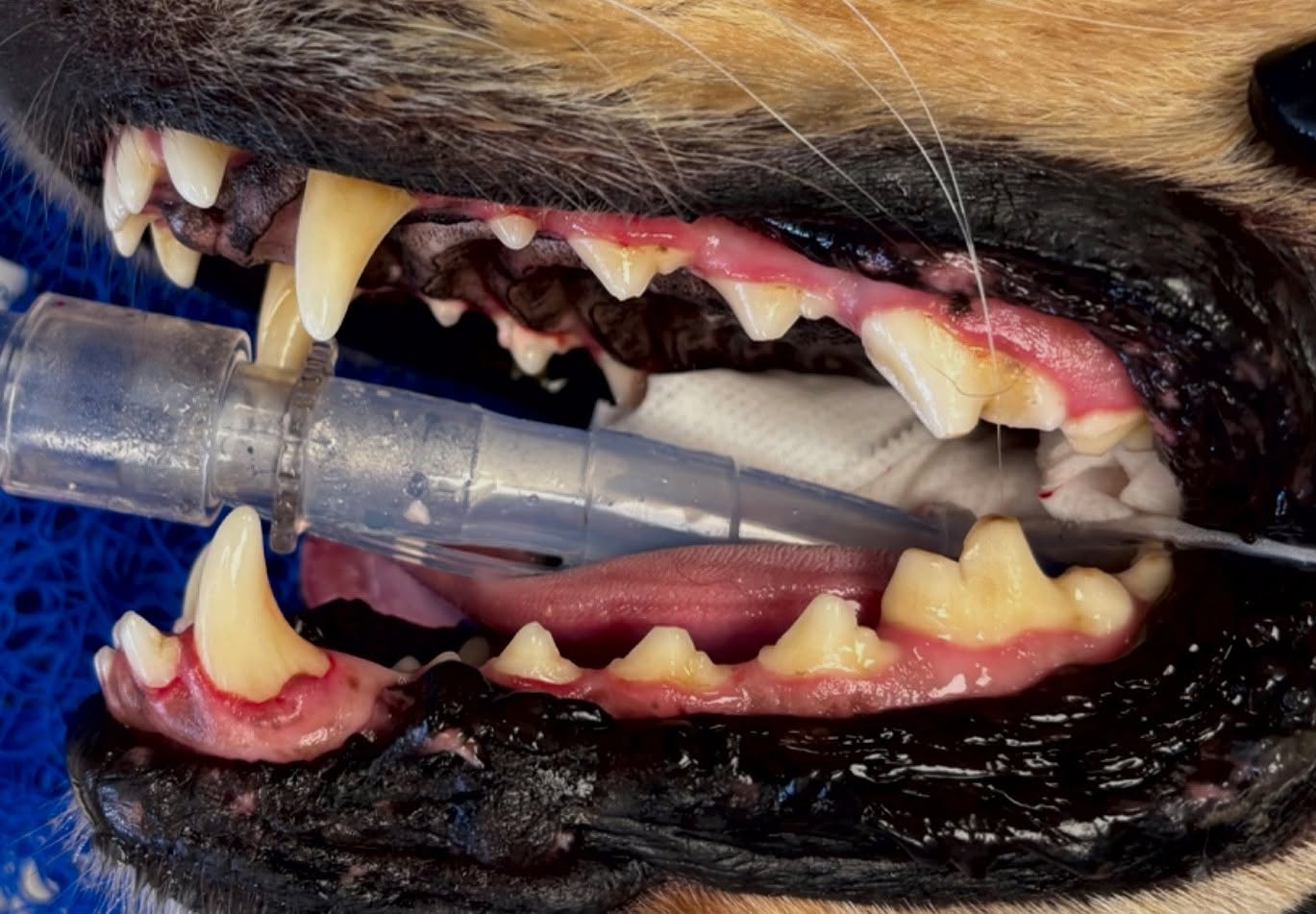
One of these teeth has an active infection breaking down the bone that holds it in place.
Can you pick it out? Neither could we — not until he was asleep.
It's the small upper tooth, the second one behind the canine.
It looks like every tooth around it.
Without anesthesia, probing, and radiographs, this tooth looks like every tooth around it. And even with all three, the answers on how to treat aren't absolute. They're based on probabilities.
Three findings that point toward extraction.
- Bone loss: about 50% along the root. That's the point where extraction is usually recommended — good odds that the disease keeps progressing and not much bone to hold it. But they are just that: odds.
- Pocket depth: 6 mm. A periodontal pocket is the gap that opens between gum and tooth as attachment is lost and bone recedes. Closed root planing — cleaning the root surface below the gumline without an incision — reaches reliably to about 5 mm. Deeper than that, the standard next step is open root planing: lifting a flap of gum to see and clean the root directly.
- Location: the pocket sat on the palate side of the tooth, where lifting the tissue wasn't practical.
In our patients there's an extra reason for extraction. Dogs and cats rarely tell us something hurts in a way we can read. Leave a failing tooth in place and the infection can spread — more root, more bone, sometimes the tooth next door.
Extraction is probably the right idea. Or is it?
Extraction has a cost. When a tooth comes out, the tooth that used to meet it loses its partner. It can collect more tartar and may need treatment of its own down the line.
A few more things weighed in.
The research is older than some of the tools. Much of the evidence behind extraction thresholds predates newer adjunct products like Periovive, a hyaluronic acid gel placed into the pocket after cleaning. Products like this are the best tool we have for a tooth like this one. What the research hasn't caught up on is how much they move the extraction thresholds. That's part of why cases like this one matter.
Follow-up is hard in veterinary dentistry. Every recheck of a pocket like this means anesthesia, cost, time off work, and remembering to book it. We work to lower those barriers. They're still real.
We don't know exactly where discomfort starts. People with periodontal pockets often don't notice them, which suggests pockets alone aren't very painful. But we sometimes see a response to probing even under anesthesia. What we do know: a root abscess hurts. This tooth isn't there yet. We have time.
Guidelines are built on odds.
Guidelines lean toward removal for a good reason — they protect patients from discomfort and disease nobody is watching. They are built on odds. Fifty percent bone loss and a 6 mm pocket don't guarantee failure.
His family was willing to do the work: diligent homecare and follow-up on schedule. That commitment changes who's watching, and it changed our recommendation. We cleaned the root, treated the pocket with Periovive, and kept the tooth.
If the recheck shows the pocket deepening, it comes out then. Trying first was a decision made with that exit in view.
Hopefully we saved a tooth.
The case for regular dental care, in one tooth.
This turned up at a routine annual cleaning, before it became an abscess. That's the case for regular dental care, in one tooth.
We're always looking to improve, because there's always more to know. Cases like this help us gather real data on the risks, benefits, and odds of success for different approaches — so the next recommendation is a little better informed.
It takes a team. Thank you to his owner, for saying yes to the hard part, and to his primary care team, for educating his family and keeping him comfortable.
More on how we weigh it: Keep the tooth, or take it out? and what radiographs find that eyes can't.
Questions about keeping a borderline tooth
Why not extract every tooth with a deep pocket?
Often that is the best option, especially when follow-up isn't realistic. But extraction has its own tradeoffs, and a guideline threshold is a probability, not a guarantee. When a family can commit to homecare and rechecks, trying to keep a borderline tooth can be a reasonable choice. When they can't, extraction is usually the kinder one.
Could this have been caught on a regular exam?
Not reliably — by anyone. An awake exam can't measure pocket depth or show bone below the gumline. Primary care veterinarians flag what can be seen and keep pets on a dental schedule, which is exactly how this one was found early. Probing and full-mouth radiographs under anesthesia do the rest.
What does homecare look like after a case like this?
Daily brushing, any home products we send, and rechecks kept on schedule. The specifics depend on the tooth, the pet, and what's realistic for the family — we set that plan together before deciding to keep a tooth.
Veterinary Dental Arts
Worth taking a look.
If it's been a while since your pet's last dental, that's reason enough.
Request a Free Exam ← All posts